Hydraulic Metallographic Mounting Press
Self-contained force generation with fine control — headroom for large moulds, high target pressures and laboratories without plant air.
Who it suits
- Laboratories without a suitable compressed-air supply
- Applications needing high mounting pressure or large mould diameters
- Workflows that want precise, repeatable pressure regulation
- Facilities consolidating multiple mount sizes on one machine
Why choose this architecture
- High force from a compact power unit — no oversized air cylinder
- Oil is incompressible: steady pressure holding through cure and cooling
- No plant compressed-air requirement; electrical and cooling utilities are configured separately
- High-force configurations can be reviewed without relying on plant air
Limitations and trade-offs
- Hydraulic oil, filters and seals introduce a scheduled service requirement
- Pump noise and heat rejection depend on the selected power unit and duty cycle
- Hydraulic actuation does not by itself guarantee better mount quality than a correctly sized pneumatic design
Utilities and installation
- Electrical supply matched to the hydraulic power unit, heater and controls
- Cooling-water connection when external or automatic water cooling is selected
- A verified closed-loop cooler can remove the permanent external-water connection on configurations that offer it
Operational concept
An electric pump pressurises hydraulic oil which acts on the ram; pressure at the specimen is regulated by the hydraulic circuit rather than by plant-air quality. Because the working fluid is incompressible, force holding during the cure and cooling phases is inherently stable — relevant for recipe-controlled mounting and shrinkage-sensitive resins.
Configuration possibilities
- Single or multi-cylinder configurations
- Fixed, HMI-adjustable or recipe-controlled pressure and temperature
- Cooling from external water connection to closed-loop recirculation
- Bench-top or floor-standing / workstation formats
- Standard and custom mould diameters with interchangeable tooling
Detailed technical specifications (dimensions, electrical load, cycle data) are defined per configuration and confirmed during engineering review — Mouldz does not publish generic catalogue values that may not apply to your machine.
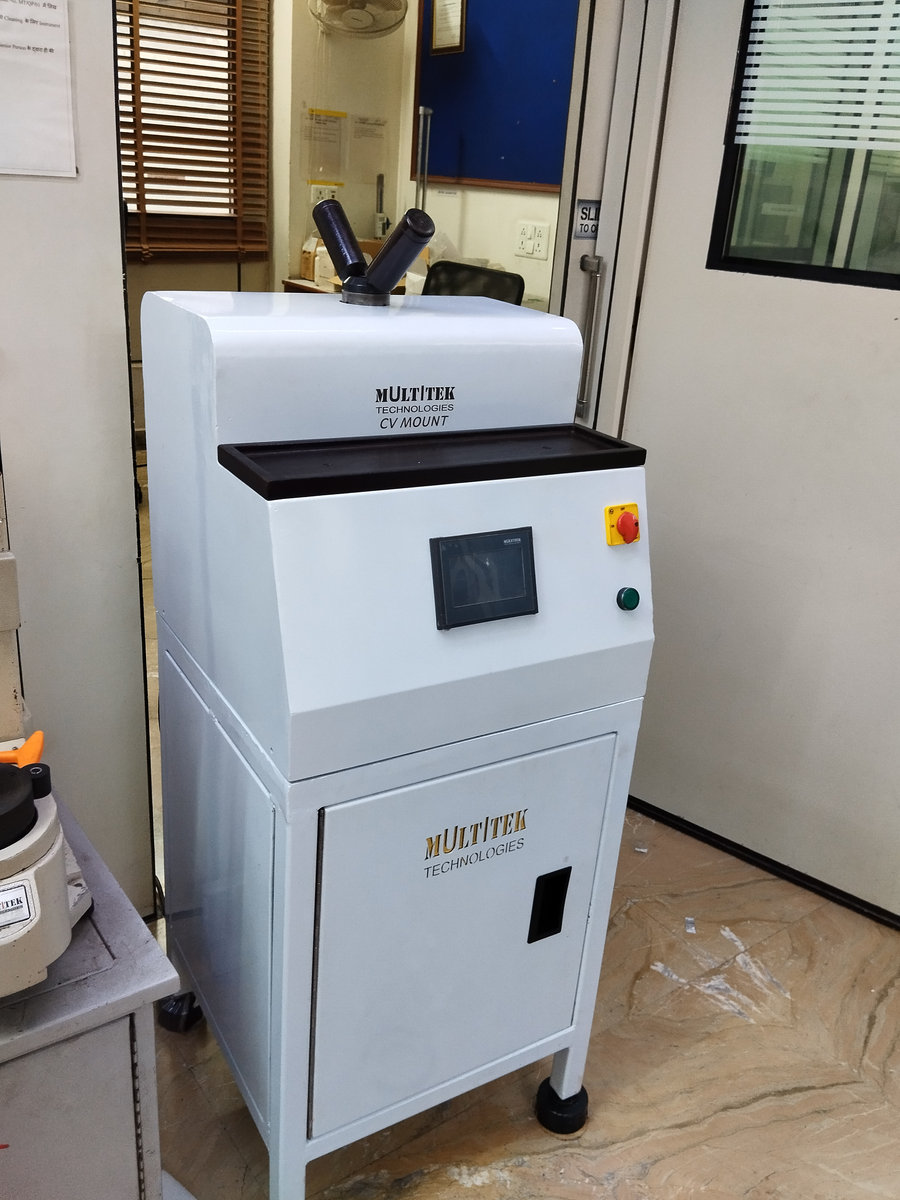
Reference configuration from Multitek
Single-chamber hydraulic reference configuration
Best suited to: Routine single-station preparation where a self-contained hydraulic force system is preferred.
- Published mould options: 25, 30 and 40 mm, with custom options noted
- Published temperature capability: up to 200 °C on this reference configuration
- Published adjustable pressure capability: up to 300 bar on this reference configuration
- Water cooling and digital temperature, pressure and cycle controls
Reference capabilities describe the cited configuration, not every machine. Final specifications are confirmed against the customer RFQ.
Verify on Multitek single-chamber mounting pressCommon questions
- When is hydraulic clearly the better choice?
- When there is no adequate plant-air supply, when the target mounting pressure or mould diameter pushes a pneumatic cylinder to impractical sizes, or when very steady pressure holding matters. For routine 25–40 mm work with good plant air, both actuation types serve well.
- Does hydraulic mean more maintenance?
- It means different maintenance: oil condition and seals instead of air treatment. Hydraulic drive is a mature, well-understood technology; service intervals are defined in the machine documentation for the specific configuration.
- Is a hydraulic press noisier?
- The pump runs during pressure build-up and regulation. Noise depends on the specific power unit and duty cycle — it is addressed during engineering review if your laboratory has strict noise requirements.