Dual-Cylinder Mounting Press
Two mounting stations with overlapping cycles — an architecture for laboratories whose measured demand exceeds one station.
Who it suits
- Laboratories where measured demand persistently exceeds one station
- Facilities with batch peaks that a single station cannot absorb
- One-operator workflows where waiting on cooling wastes skilled time
- Labs standardising two mount diameters side by side
Why choose this architecture
- One mount cools while the next heats — cycle phases overlap
- Potentially higher output by overlapping otherwise serial cycle phases
- Two diameters can be tooled simultaneously if required
- Often more effective than faster heaters: cooling dominates cycle time
Limitations and trade-offs
- Two stations do not automatically double output; operator handling and shared utilities still limit capacity
- A wider machine and higher simultaneous utility demand need installation planning
- Independent station behaviour is confirmed per configuration rather than assumed
Utilities and installation
- Electrical capacity sized for the selected heaters, controls and station duty
- Plant air for pneumatic actuation, or a hydraulic power unit where configured
- Cooling-water flow or a closed-loop system sized for overlapping station cycles
Operational concept
Two mould assemblies share the machine frame and controls. While station A is in its cooling phase, station B heats and cures. The operator alternates loading and unloading, so the expensive phases run in parallel rather than in sequence. Beyond two stations, the same principle extends to three or more cylinders for very high volumes — the architecture is not capped at dual.
Configuration possibilities
- Pneumatic or hydraulic actuation
- Independent or shared temperature/pressure settings per station (per configuration)
- Mixed mould diameters with interchangeable tooling
- Automatic water cooling or closed-loop cooling for sustained duty
- Semi-automatic or fully automatic cycles; recipe-controlled operation
Detailed technical specifications (dimensions, electrical load, cycle data) are defined per configuration and confirmed during engineering review — Mouldz does not publish generic catalogue values that may not apply to your machine.
Reference configuration from Multitek
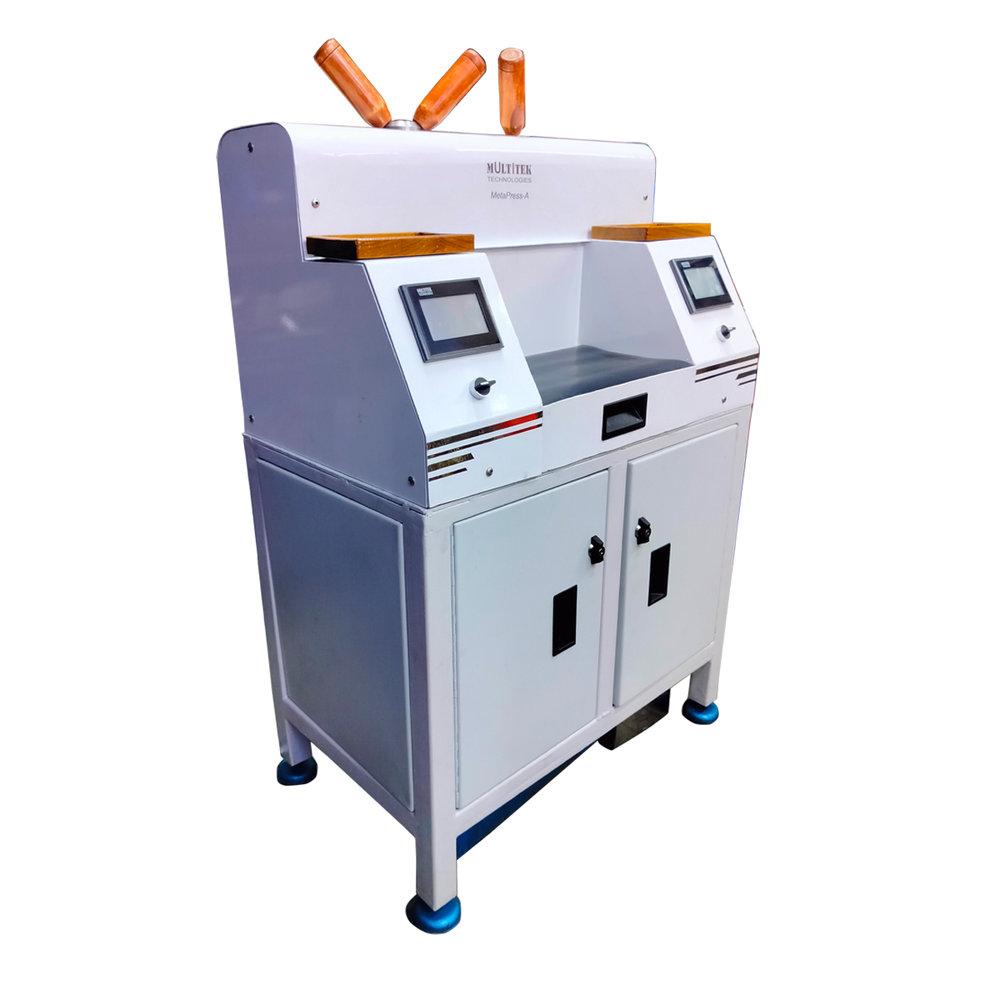
Dual-station reference configuration
Best suited to: Laboratories where mounting becomes a measured throughput bottleneck and cycle phases can overlap.
- Two mounting chambers for overlapping specimen preparation
- Touchscreen operation and temperature/pressure control on Multitek's published reference
- Hydraulic actuation and water cooling on the published reference
- Final station independence, utilities and tooling confirmed against the RFQ
Reference capabilities describe the cited configuration, not every machine. Final specifications are confirmed against the customer RFQ.
Verify on Multitek double-chamber mounting pressCommon questions
- Does a dual-cylinder press really double throughput?
- Not necessarily. The theoretical ceiling is two stations working in parallel, but real gains depend on handling time, operator availability, cooling and any shared machine resources. The throughput calculator provides an estimate using your cycle data.
- Can the two stations run different mount sizes?
- That is a configuration question — mixed-diameter tooling is a common request and is specified during engineering review, including its effect on force and pressure calibration per station.
- Is there anything beyond dual-cylinder?
- Yes. When measured demand approaches the calculated capacity of two stations, three or more stations and custom multi-station layouts can be specified through the configurator. The decision uses cycle time, productive shift duration and utilisation rather than a universal daily threshold.